Enterprise Software for Complex Organizations
Architect, build, and integrate resilient enterprise platforms that unify multi-department workflows, legacy infrastructure, distributed data sources, and governance frameworks into high-velocity operational environments.
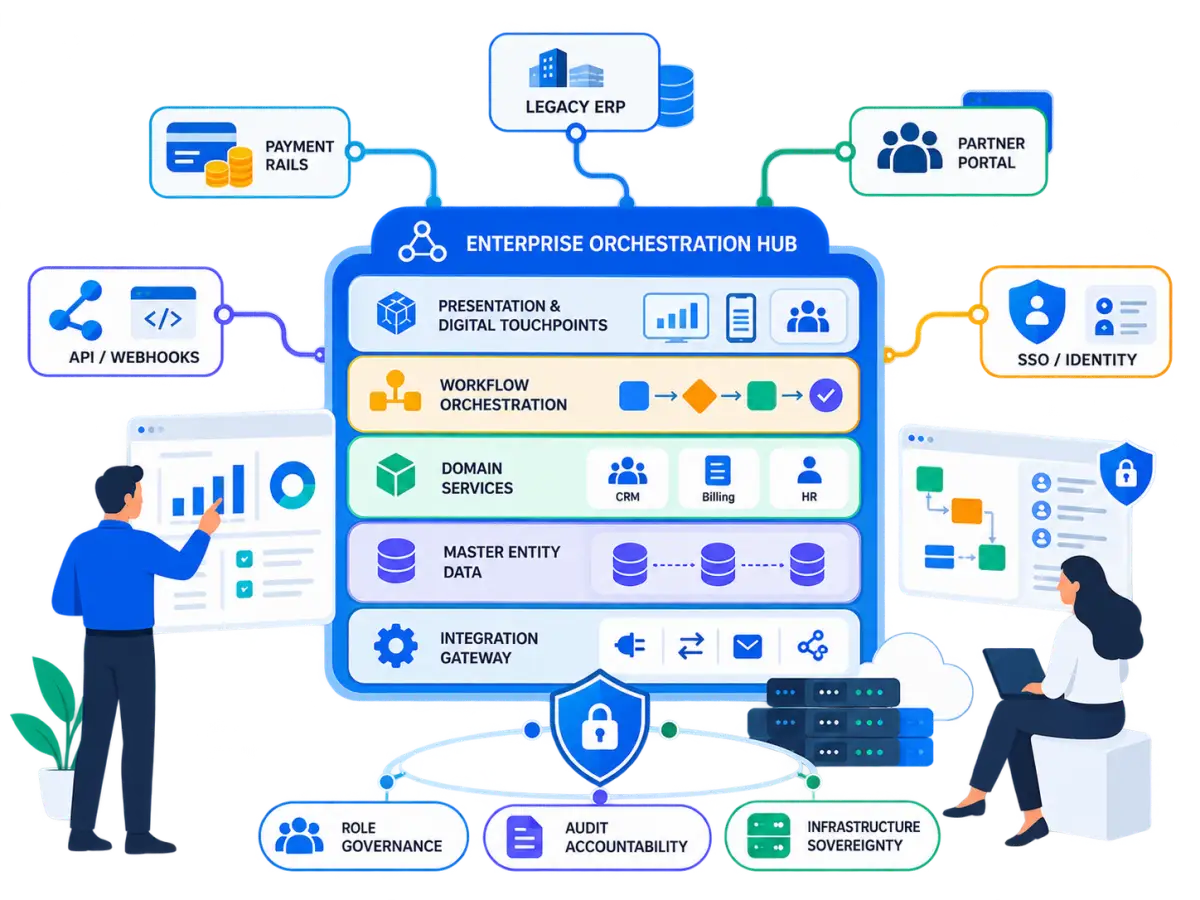
When Disconnected Systems Constrain Enterprise Agility
As organizations scale across business units, regional branches, and legacy software stacks, operational friction compounds. Standalone tools and disconnected databases force teams into manual workarounds, creating data silos, reconciliation delays, and governance vulnerabilities.
Cross-Department Bottlenecks
Handoffs between sales, operations, billing, and fulfillment require manual re-keying and email chasing, causing cycle delays and errors.
Fragmented Master Data
Customer, inventory, and financial records reside across isolated applications without a single, authoritative source of truth.
Legacy System Rigidity
Dated core systems lack modern API connectivity, preventing workflow automation and slowing digital transformation initiatives.
Governance & Audit Blindspots
Distributed software makes access control enforcement, regulatory tracking, and audit logging difficult to maintain reliably.
Fragmented Enterprise (Point Solutions)
- Disjointed tools with manual data synchronization
- Inconsistent master records across business units
- Compounding per-user recurring licensing fees
- Delayed cross-departmental reporting and auditing
Unified Enterprise Platform (Cohesive Core)
- Standardized workflow handoffs and automated routing
- Synchronized master data with strict schema validation
- Full source code ownership with zero per-seat fees
- Real-time operational telemetry and tamper-proof audit trails
A Multi-Tier System Landscape Engineered for Cohesion and Stability
We structure enterprise software around decoupled architectural tiers. This ensures user interfaces, business logic rules, transaction engines, and external integrations remain maintainable and resilient as organizational requirements expand.
Presentation & Digital Touchpoints
Role-tailored web command centers, field mobile tools, partner portals, and executive reporting views designed for distinct departmental user groups.
Workflow Orchestration & Business Rules
State machines and configurable business logic engines that execute approvals, enforce validation constraints, and trigger automated downstream actions.
Domain Services & Operational Core
Encapsulated business modules managing CRM, financial ledgers, workforce logistics, academic scheduling, procurement, and billing operations.
Data Backbone & Master Entity Registry
ACID-compliant relational transactional databases, caching layers, and master data management schemas ensuring data integrity and consistency.
Integration Gateway & Security Perimeter
Secure API middleware, message queues, and identity federation connectors linking the core platform with legacy ERPs, payment gateways, and banking rails.
Software Systems Tailored to Enterprise Operating Models
From multi-department operational backbones to specialized transaction engines, we build scalable software systems designed around specific organizational workflows.
Unified Operations & Management Platforms
Centralized systems that connect inventory, procurement, workforce scheduling, project execution, and billing into an unbroken operational pipeline.
- Multi-location branch and entity management
- Resource allocation and capacity planning
- Automated cross-departmental approval chains
- Operational telemetry and KPI dashboards
Multi-Department Workflow & Collaboration Portals
Secure digital workspaces tailored to distinct corporate teams—finance, human resources, compliance, and legal—with strict role boundaries.
- Department-specific views and data filters
- Document routing, verification, and sign-offs
- Configurable compliance checklists and audits
- Automated notification and escalation alerts
Partner, Supplier & B2B Client Networks
Secure extranets enabling seamless data interchange between your organization and external vendors, distributors, and institutional clients.
- Vendor onboarding and contract verification
- Automated purchase order and invoice exchange
- Real-time order tracking and shipment status
- Granular external partner permission models
High-Throughput Transaction & Billing Engines
Reliable calculation backbones capable of processing complex fee schedules, high-volume recurring invoicing, payroll cycles, and multi-currency ledgers.
- Custom dynamic pricing and rate card rules
- Batch invoice generation and ledger posting
- Automated tax calculation and statutory reporting
- Bank reconciliation and settlement logging
Where Enterprise Applications and External Systems Converge
Enterprise platforms do not operate in isolation. We engineer resilient integration layers, message queues, and bidirectional API pipelines that connect new enterprise software with legacy databases, third-party ERPs, payment rails, and communication channels.
Bi-Directional API Gateways
Secure REST and GraphQL interfaces with rate-limiting, authentication tokens, and payload validation for real-time external system communication.
Event-Driven Message Queues
Asynchronous message buses that handle high-volume transactional events without blocking frontend user workflows.
Enterprise Identity & SSO
Federated authentication integration supporting corporate single sign-on, centralized user provisioning, and directory synchronization.
Financial & Payment Rails
Direct integrations with banking settlement APIs, payment gateways, tax calculation engines, and automated clearing networks.
Omnichannel Communications
Automated notification pipelines delivering transactional alerts, statements, and operational reminders across channels.
Legacy Database & ERP Connectors
Engineered ETL scripts and change-data-capture pipelines that safely read from and synchronize with existing legacy databases.
Granular Authorization, Multi-Tenant Hierarchies & Audit Accountability
Enterprise platforms must govern data access across hundreds or thousands of users with varying organizational authority, department boundaries, and compliance mandates.
Role-Based Access Control (RBAC)
Defines precise read, write, edit, and approve permissions mapped to corporate job roles, departments, and managerial tiers.
Multi-Branch Data Partitioning
Enforces logical data isolation between regional branches or business entities while allowing centralized executive consolidation.
Immutable Audit Event Logs
Maintains tamper-proof records of every transactional change, user login, data export, and approval with precise timestamps and IP tracking.
Segregation of Duties (SoD)
Prevents operational conflicts by requiring dual-authorization gates for sensitive actions like high-value disbursements or master data edits.
Multi-Role Authorization & Scope Model
| Operational Domain | Executive Leadership | Department Manager | Operational Staff | External Partner |
|---|---|---|---|---|
| Strategic Financial Ledgers | Full Read / Audit | Departmental Only | No Access | No Access |
| Cross-Department Approvals | Final Sign-off | Review & Forward | Initiate Only | No Access |
| Master Data Management | Policy Approval | Edit with Log | View Only | No Access |
| Operational Records & Orders | Global Telemetry | Manage Team Queue | Create & Edit | Self-Service View |
Deterministic Data Pipelines That Eliminate Information Latency
In an enterprise software environment, a single customer or operational transaction triggers synchronized updates across multiple departmental systems in real time.
Event Ingestion & Validation
A transaction is initiated via portal, mobile app, or external API. Input data undergoes strict schema and business rule validation.
State Machine Processing
The core engine evaluates permissions, applies custom business formulas, and transitions the record to the next lifecycle stage.
Cross-Department Propagation
Asynchronous message queues dispatch synchronized events to inventory, scheduling, notifications, and customer engagement queues.
Ledger Posting & Audit Trail
Financial impact is written to the general ledger, audit logs record the event, and real-time executive dashboards update instantaneously.
Architectural Rigor That Ensures Long-Term Maintainability
Enterprise platforms must endure for years without accumulating crippling technical debt. We adhere to disciplined software engineering standards that prioritize readability, testability, and infrastructure portability.
Domain-Driven Modular Design
Business logic is strictly decoupled from presentation and database access layers, allowing modules to be modified without unintended side effects.
Deterministic Schema Migrations
All database changes are managed via version-controlled migration scripts, ensuring reliable deployment across development, staging, and production.
Comprehensive Telemetry & Observability
Built-in application performance monitoring, structured error logging, and health check endpoints facilitate proactive issue resolution.
Infrastructure Sovereignty
Systems are designed to run in your environment of choice—private cloud, on-premise servers, AWS, or Azure—without proprietary vendor lock-in.
Extending and Modernizing Legacy Systems Without Operational Disruption
Enterprises cannot afford to halt core operations for multi-year software rewrites. We utilize proven modernization patterns to evolve legacy systems step-by-step while maintaining business continuity.
Strangler Fig Migration
Decommission legacy system functionality incrementally by routing specific workflows to new modern services behind a unified proxy gateway.
API Wrapper & Gateway Layers
Encapsulate dated legacy databases and backends behind secure, modern REST and GraphQL APIs to enable new digital portals immediately.
Dual-Write Data Synchronization
Deploy change-data-capture connectors to ensure live data consistency between the legacy database and the new enterprise data core.
Modular UI Modernization
Replace slow desktop applications with fast, responsive, web-based interfaces while preserving validated backend business logic.
Rigorous Validation for Mission-Critical Operating Environments
In enterprise systems, software errors can disrupt supply chains or corrupt financial records. We implement exhaustive validation pipelines before any code reaches production.
Automated Business Logic & Unit Tests
Verify that complex tax calculations, fee formulas, and workflow transitions behave deterministically across boundary conditions.
API Contract & Integration Testing
Validate bidirectional payload schemas and error handling across third-party ERPs, payment gateways, and communication channels.
High-Concurrency Stress & Load Testing
Simulate peak operational traffic to verify database connection pool resilience, query optimization, and response latency.
Security, Role Boundary & Audit Audits
Verify that users cannot bypass RBAC restrictions, access cross-branch data, or perform unauthorized transactional modifications.
Enterprise Engineering Foundations Proven in Production
Our custom enterprise software engineering is backed by our proven proprietary platform foundations—designed, deployed, and refined for complex institutional operations.
VheTM Platform
Comprehensive enterprise platform managing training logistics, course scheduling, instructor assignments, attendance tracking, and multi-tier institutional invoicing.
EduSec Platform
Enterprise institutional software governing the full student lifecycle, admissions pipelines, academic compliance, fee collection, and departmental administration.
Rudram Core Suite
Decoupled business modules delivering double-entry financial ledgers, automated payroll calculation, and pipeline tracking ready to integrate into custom enterprise stacks.
When Does Your Organization Require Enterprise-Grade Engineering?
Selecting the right software approach depends on operational scale, system integration requirements, and proprietary workflow complexity.
Standard Off-the-Shelf SaaS
Appropriate for non-differentiating functions (like basic email or standard helpdesk) where out-of-the-box workflows require no structural customization.
Custom Departmental Application
Ideal when a single business unit needs a specialized tool to replace spreadsheets without extensive cross-departmental integration.
Integrated Enterprise Platform
Essential when multiple business units, regional branches, legacy databases, and complex approval rules must operate as one synchronized ecosystem.
Enterprise Software Applied Across Complex Sectors
How our enterprise architectural approach adapts to distinct regulatory mandates, multi-location structures, and high-volume transaction environments.
Education & Training Networks
Centralized platform architectures coordinating multi-campus admissions, faculty allocations, fee structures, and regulatory compliance reporting.
Professional & Corporate Services
Enterprise management software connecting client engagement pipelines, project milestones, consultant time logs, and multi-tier billing.
Wholesale Commerce & Distribution
Unified operational backbones managing multi-warehouse stock visibility, custom distributor rate cards, and automated order fulfillment.
Industrial & Manufacturing Operations
Production scheduling software coordinating raw material requisition, quality check gates, maintenance logs, and supply chain handoffs.
Enterprise Solutions in Active Operation
Real-world examples of how unified enterprise software engineering solves operational complexity.
Multi-Campus Training Institution Platform
A large vocational training provider struggled with disconnected student records, manual timetable scheduling across 12 centers, and multi-week delays in corporate client billing.
Architected a centralized enterprise management platform unifying course scheduling, trainer allocations, student attendance tracking, and automated corporate invoice generation.
Industrial Equipment Distributor Unified Operations
A regional equipment supplier suffered from siloed branch databases, manual pricing calculations, and offline order tracking between field sales and warehouse dispatchers.
Engineered a unified multi-branch operations platform with role-based sales ordering, automated tier-based pricing rules, warehouse inventory allocation, and general ledger posting.
Frequently Asked Questions About Enterprise Software Development
Clear, source-grounded answers about enterprise software architecture, legacy system integration, data security, and rollout methodology.
How does Rudram approach integrating new enterprise software with legacy systems?
We employ non-disruptive integration strategies including modern API wrapper layers, event-driven message queues, and scheduled change-data-capture pipelines. This enables new web and mobile applications to read from and write to existing legacy databases without requiring high-risk, big-bang system replacements.
How do you ensure data security, role segregation, and audit compliance across large teams?
We engineer granular Role-Based Access Control (RBAC) and Attribute-Based Access Control (ABAC) directly into the core architecture. Every database transaction, login event, and permission change is recorded in an immutable, timestamped audit log. Sensitive actions enforce segregation of duties with multi-level approval workflows.
Can we deploy the enterprise software in our private cloud or on-premise infrastructure?
Yes. We build enterprise software with complete deployment flexibility. Systems can be hosted in your private cloud (AWS, Azure, Google Cloud), on dedicated bare-metal servers, or in your secure on-premise data center. You retain full administrative control and data sovereignty.
How do you handle phased rollouts to prevent disruption to active operations?
We utilize incremental deployment methodologies such as the Strangler Fig pattern. High-priority workflows or specific departmental modules are developed, validated in staging sandbox environments, and rolled out in structured phases. Teams can continue daily operations while transitioning smoothly.
Who owns the intellectual property and source code upon project completion?
You own 100% of the custom source code, database architectures, and intellectual property developed for your enterprise system upon contract fulfillment. There are no proprietary runtime lock-ins or recurring per-user software licensing fees.
What ongoing enterprise SLA, maintenance, and support frameworks do you provide?
We provide structured enterprise maintenance agreements including guaranteed response SLAs, scheduled security patching, database optimization, continuous telemetry monitoring, and dedicated engineering support for feature evolution.
Let's Discuss Your Enterprise Software Architecture
Speak directly with an enterprise software architect to review your current systems landscape, identify operational bottlenecks, and plan a resilient engineering roadmap.