Refactor, Re-Platform, and Modernize Legacy Software Without Disruption
We transform brittle legacy codebases, monolithic architectures, and unmaintainable database schemas into modular, secure, cloud-ready software systems. Using incremental refactoring, the Strangler Fig pattern, and zero-data-loss validation pipelines, we eliminate technical debt while keeping your business running 24/7.
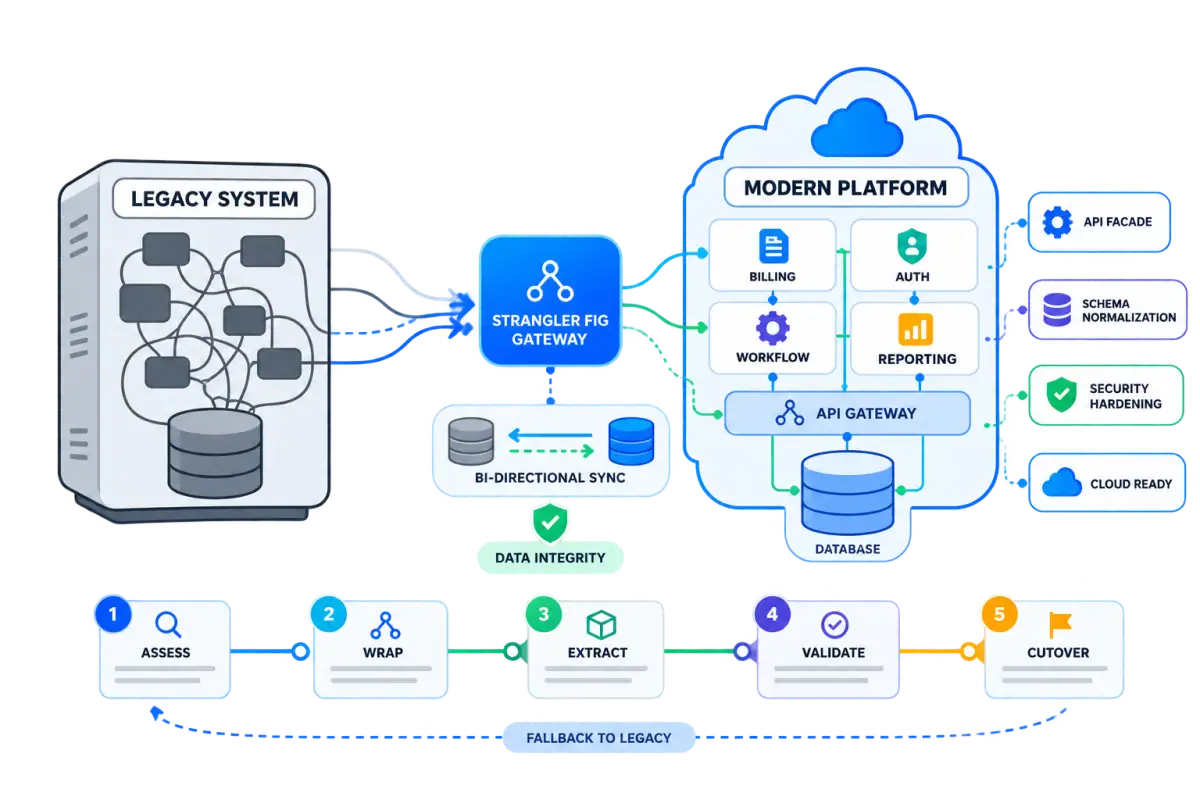
The Hidden Cost and Fragility of Aging Monolithic Systems
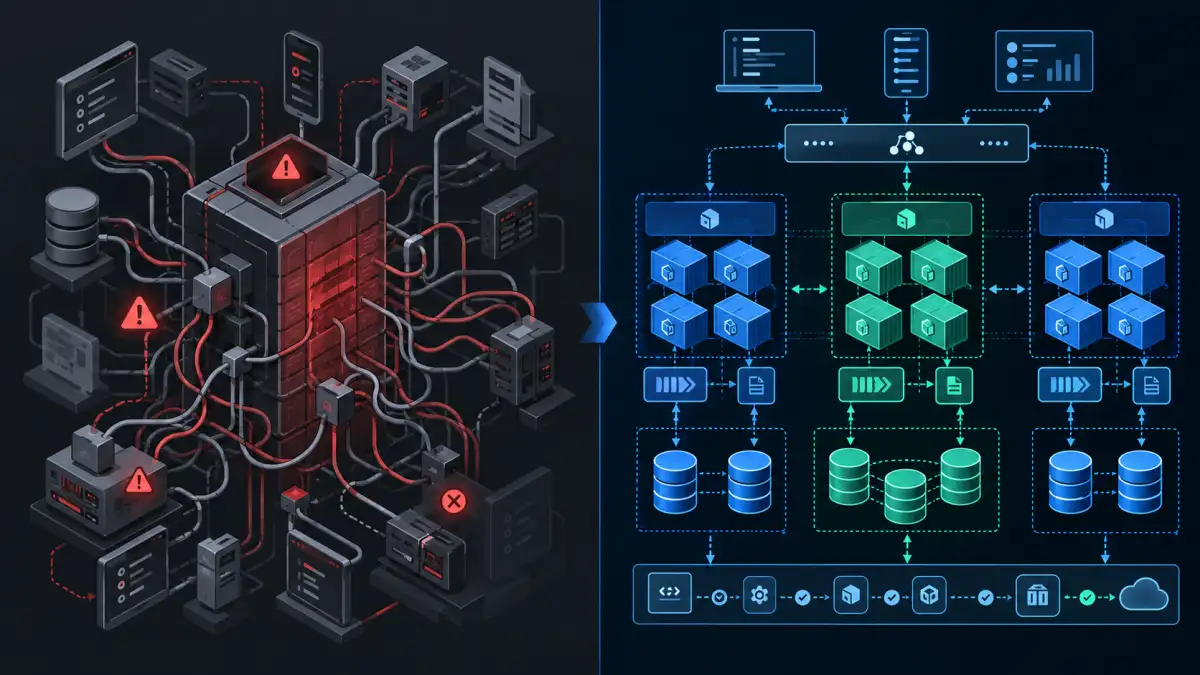
Legacy software often turns into a brittle "black box" where simple feature changes cause unexpected outages, deprecated runtimes create catastrophic security risks, and slow databases paralyze daily work.
The Fragile Legacy Monolith Trap
- Spaghetti procedural code where editing one function breaks unrelated modules across the system
- Outdated PHP/framework versions with critical unpatched CVE security vulnerabilities and zero vendor support
- Denormalized, unindexed databases suffering from severe table locking, data duplication, and slow reporting
- Zero API capability, blocking mobile app development, third-party integrations, and AI workflow automation
- Single-developer dependency where only one original author understands how the proprietary system operates
Rudram Modular Target Architecture
- Clean Domain-Driven Design (DDD) with decoupled services, repository patterns, and strict type safety
- Modern, supported runtime (PHP 8.2+ / Yii2 / Python) running inside secure Docker containers
- Normalized relational database with strict foreign keys, transactional ACID integrity, and sub-50ms queries
- OpenAPI 3.0 documented RESTful API layer connecting web portals, mobile apps, and external services
- Comprehensive documentation, automated regression test suites, and 100% intellectual property ownership
Security De-Risking
Eliminate critical security vulnerabilities, outdated cryptographic hashes (MD5/SHA1), and injection risks by upgrading to modern secure frameworks.
Schema Normalization
Cleanse corrupted records, resolve duplicate entries, establish relational integrity constraints, and optimize index trees for instant queries.
Performance Re-Engineering
Replace N+1 query loops and synchronous blocking processes with Redis caching, asynchronous job queues, and optimized SQL joins.
API-First Interoperability
Expose secure RESTful endpoints and webhooks over legacy domain logic, unlocking mobile apps, SaaS integrations, and automated workflows.
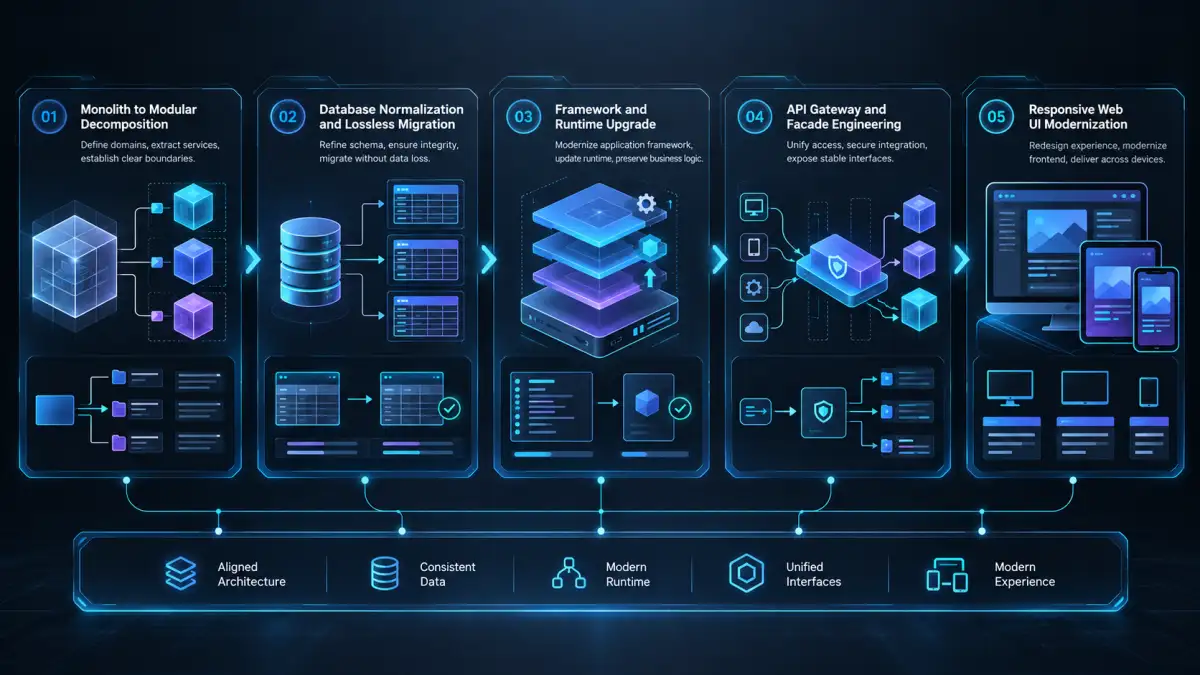
Five Engineering Disciplines That Safely Upgrade Mission-Critical Systems
We apply disciplined software engineering to deconstruct monolithic code, sanitize data stores, and establish modern developer workflows without interrupting daily business.
Monolith-to-Modular Decomposition
We decompose tightly coupled procedural monoliths into clean, modular service boundaries (e.g. Invoicing, Inventory, Auth) that can be maintained independently.
Schema Sanitization & Zero-Loss Migration
We clean legacy tables, normalize denormalized structures, sanitize corrupted records, and migrate millions of rows with automated row-level checksum verification.
Framework & Runtime Upgrades
We safely upgrade deprecated language versions (PHP 5.x/7.x to PHP 8.2+, legacy frameworks to modern Yii2) while refactoring deprecated syntax and APIs.
API Gateway & Facade Engineering
We build secure API facades (OpenAPI 3.0) on top of legacy core logic, allowing new web portals and mobile applications to communicate seamlessly with existing backends.
Responsive UI/UX Modernization
We replace clunky desktop-only tables and legacy UI forms with high-speed, mobile-responsive Bootstrap 5 web interfaces optimized for operator ergonomics.
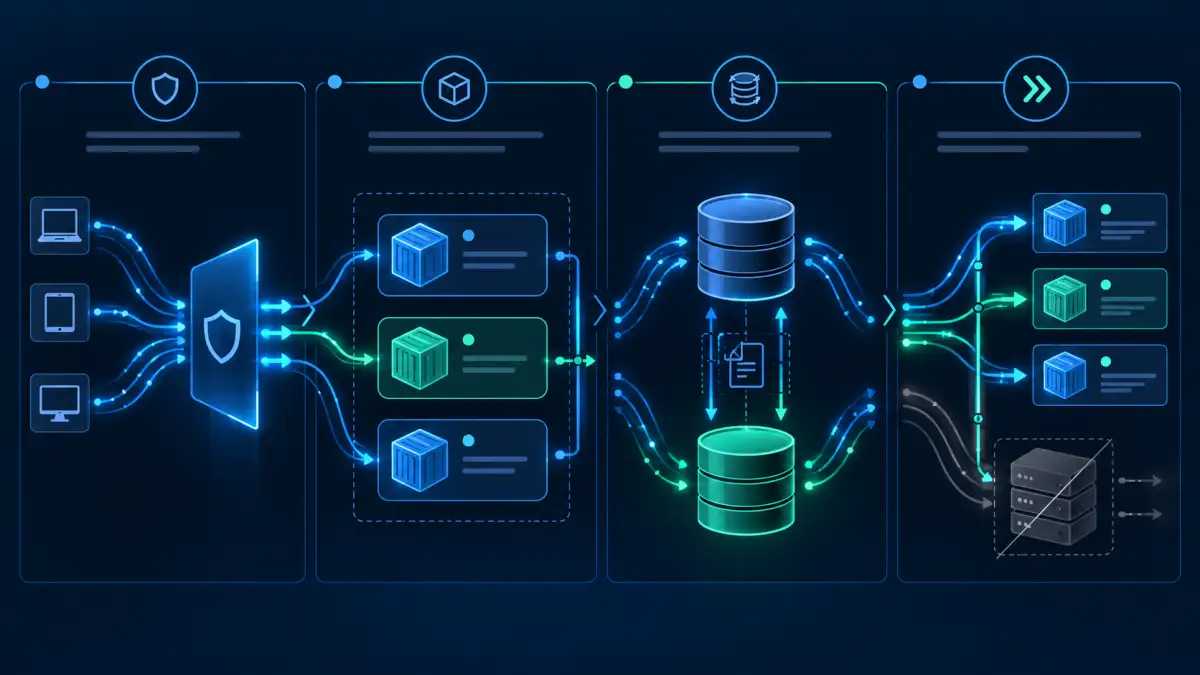
How We Incrementally Replace Legacy Code Without Big-Bang Risk
Big-bang rewrites carry a 70%+ failure rate due to scope creep and cutover surprises. We use the proven Strangler Fig pattern to migrate functionality module by module with zero business disruption.
API Gateway Interception & Routing
We deploy an intelligent reverse proxy (Nginx / API Gateway) in front of the legacy application to inspect incoming requests and route traffic selectively.
Bounded Context Extraction
We extract a single operational module (e.g. Billing or Authentication) into a clean, modern service backed by automated unit tests and strict data contracts.
Bi-Directional Database Sync (CDC)
We implement Change Data Capture (CDC) and transactional dual-write pipelines so both legacy and modern systems share identical real-time data states.
Progressive Cutover & Decommission
Traffic shifts permanently to the modernized module once telemetry confirms 100% accuracy. The legacy code for that module is cleanly retired.
Selecting the Optimal Modernization Strategy for Every Component
Not every line of legacy code requires a complete rewrite. We categorize each component across the 6R architectural framework to maximize business value and return on investment.
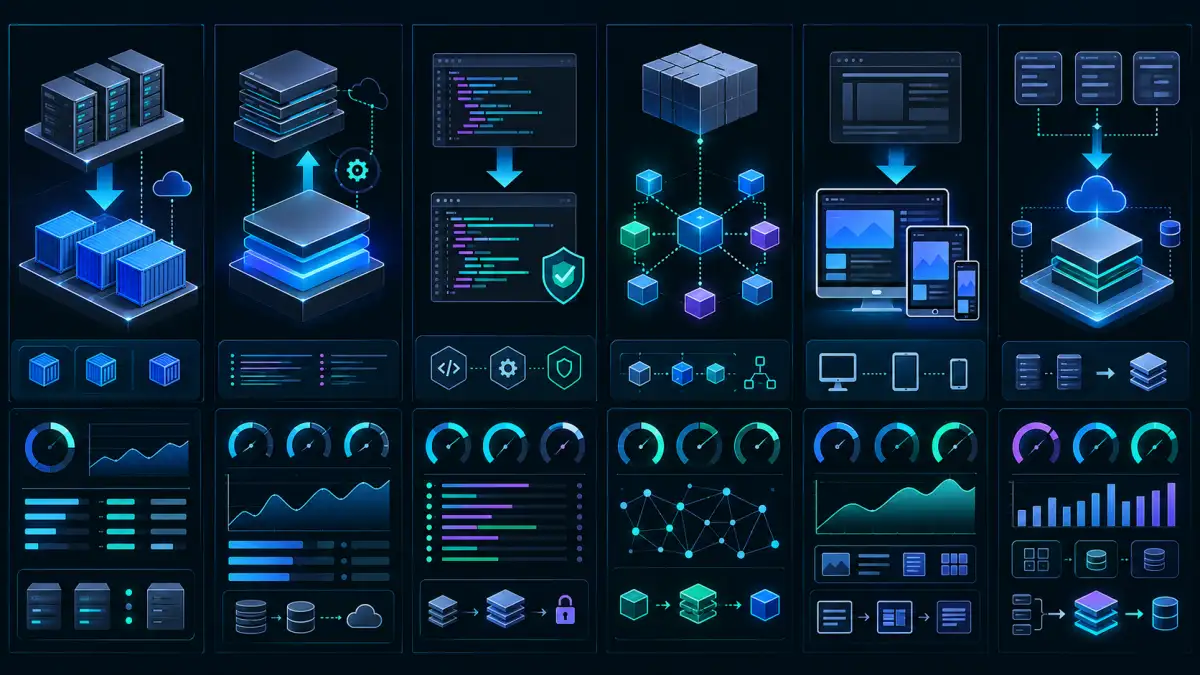
Re-Host (Cloud Containerization)
Package existing stable applications into lightweight Docker containers and migrate from on-premise physical servers to resilient cloud VPC infrastructure.
Re-Platform (Runtime & OS Upgrade)
Upgrade underlying language runtimes (e.g. PHP 8.2+), database versions (MySQL 8 / PostgreSQL 16), and web servers without altering core business logic.
Refactor (Code Quality & Security)
Restructure internal codebases to eliminate duplicate procedural functions, fix SQL injection vulnerabilities, and introduce type safety and unit testing.
Re-Architect (Modular Decomposition)
Deconstruct large monolithic codebases into modular services, domain boundaries, and event-driven asynchronous queues for independent scaling.
Re-Build (Modern UI/UX Web Interface)
Re-engineer frontend interfaces using responsive Bootstrap 5 and semantic HTML5, replacing outdated desktop forms with intuitive web dashboards.
Replace & Consolidate (Platform Migration)
Retire non-differentiating legacy modules and migrate them directly to proven Rudram enterprise platforms (VheTM, EduSec, Rudram Invoice).
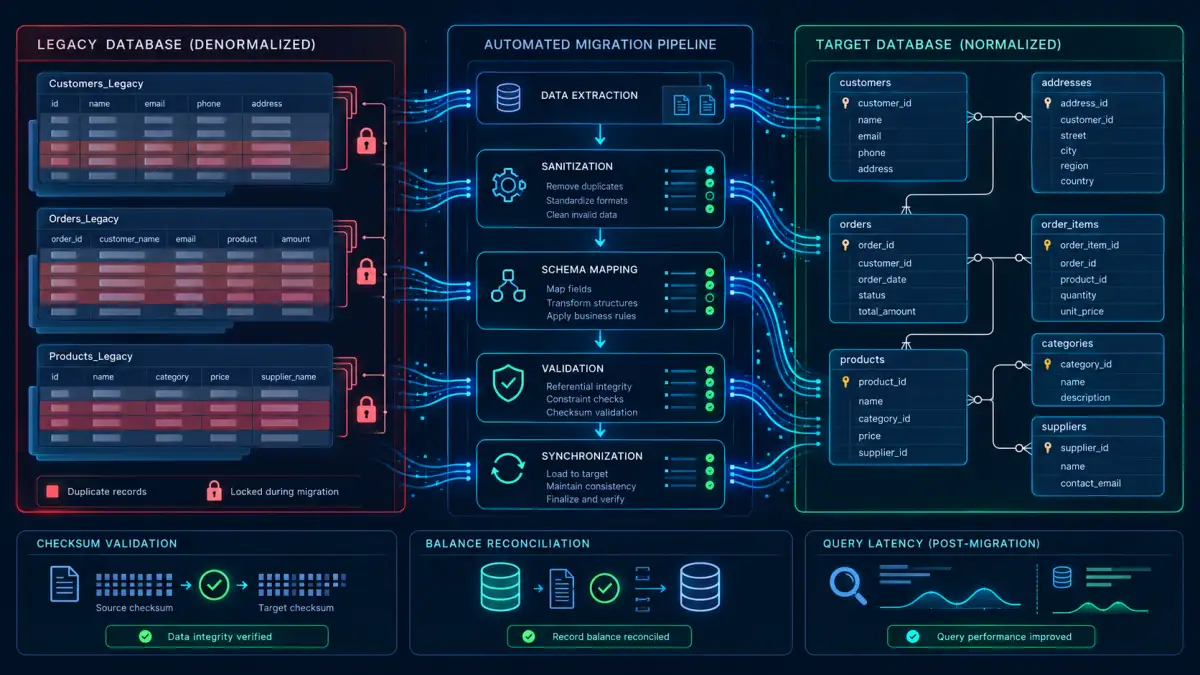
Sanitizing, Normalizing, and Migrating Decades of Operational Data
Your database holds the institutional memory and financial ledger of your business. We design rigorous schema migration pipelines with cryptographic validation.
Schema ERD Reverse-Engineering
We map undocumented database structures, extract implied table relationships, identify primary key deficiencies, and construct clean relational ERDs.
Data Cleansing & Deduplication
Automated scripts identify and sanitize orphaned child records, invalid UTF-8 characters, duplicate customer profiles, and corrupted balance columns.
Row-by-Row Cryptographic Verification
Every single migrated record is verified using automated SHA-256 row checksums and numerical sum reconciliations between legacy and modern tables.
Bi-Directional Change Data Capture (CDC)
Real-time synchronization ensures that updates in either system reflect instantly in both during phased transition periods with zero dropped transactions.
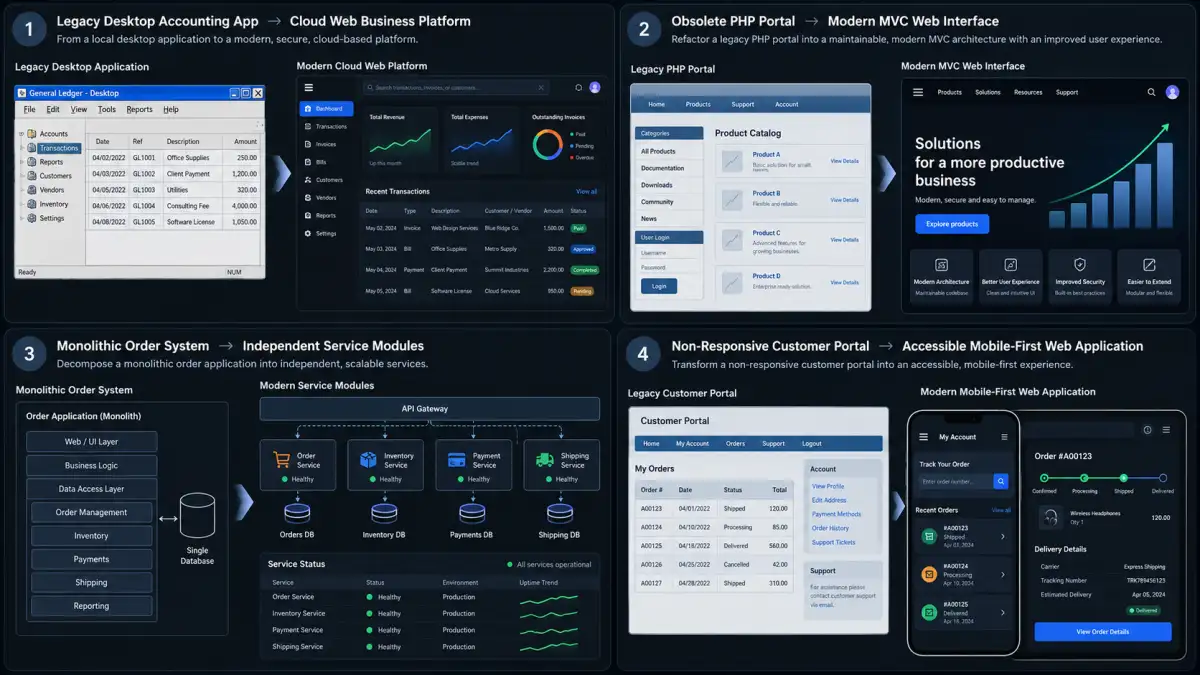
Common Legacy Architectures We Transform for Growing Enterprises
Explore the typical legacy bottlenecks we solve and the tangible operational improvements achieved through disciplined re-engineering.
Legacy Desktop ERP & FoxPro/VB Migration to Web
Client operated a 15-year-old on-premise desktop accounting and inventory system requiring VPN access and physical office servers with frequent database lockups.
Extracted business rules, normalized the database into PostgreSQL, and engineered a modern, browser-based web application with role-based access and remote multi-branch synchronization.
- Eliminated dedicated on-premise server maintenance and VPN hardware costs
- Branch managers gained instant real-time stock and billing visibility on any device
- Zero operational downtime achieved during cutover with dual-write database sync
PHP 5.x Spaghetti Codebase Upgrade to Modern Yii2
A large vocational training portal built in unmaintained procedural PHP 5.4 suffered from frequent crashes, SQL injection vulnerabilities, and 8-second page load times.
Refactored code into clean MVC architecture on PHP 8.2 and Yii2, optimized database queries, added Redis caching, and automated CI/CD deployment.
- Page response latency dropped from 8.2 seconds to under 420 milliseconds
- Resolved 14 severe OWASP security vulnerabilities and patched all unmaintained CVEs
- Engineering team can now ship new features weekly with automated regression tests
Monolithic Commercial Platform to Modular Architecture
A high-transaction distribution company had an interconnected monolith where order processing, invoicing, and inventory were locked in one massive 50,000-line script.
Applied the Strangler Fig pattern to extract order management and invoicing into independent domain services communicating via high-speed RESTful APIs.
- Isolated failure domains so an inventory recalculation never freezes order checkouts
- Enabled external logistics partners to integrate directly via OpenAPI endpoints
- Database query concurrency increased by 350% under peak sales traffic
Legacy Customer Portal Modernization with Mobile APIs
A customer service portal built in 2011 was non-responsive on smartphones, lacked modern payment gateways, and had zero self-service options for customers.
Built a modern, mobile-first responsive web portal on Bootstrap 5 paired with a secure REST API backend supporting online payments, PDF receipts, and automated notifications.
- Customer mobile self-service increased by 75%, cutting support phone call volume
- Integrated modern payment gateways with automated instant ledger reconciliation
- Full WCAG 2.1 accessibility compliance achieved across all customer touchpoints
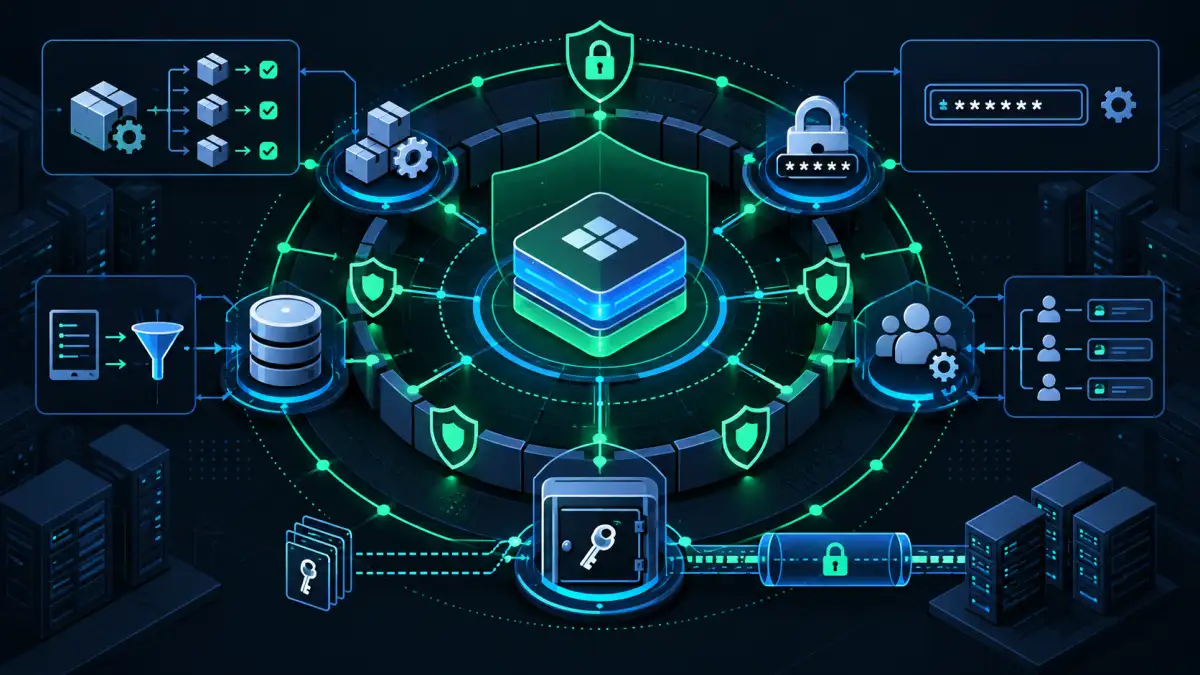
Remediating Critical CVEs and Hardening System Perimeters
Aging applications are the primary target for cyber threats and ransomware. We identify and eliminate security risks across application code, dependencies, and data storage.
Outdated Dependency & CVE Patching
We audit all third-party libraries and replace deprecated, unpatched components with modern, actively maintained security releases.
Modern Cryptography & Hashing
We upgrade obsolete MD5/SHA1 password hashes to state-of-the-art Argon2id/bcrypt algorithms with transparent, seamless user re-encryption upon login.
Parameterized SQL Injection Fixes
We rewrite raw concatenated SQL queries using secure parameterized prepared statements, completely eliminating OWASP A03 injection vulnerabilities.
Granular Role-Based Access Control (RBAC)
We replace hardcoded permission checks with granular, centralized RBAC policies and immutable administrative audit logs.
Secrets Management & TLS Enforcement
We extract hardcoded database passwords from codebases into encrypted environment vaults and enforce strict TLS 1.3 encryption across all endpoints.
Automated Static & Dynamic Security Scans
We integrate continuous SAST/DAST vulnerability scanners into the CI/CD pipeline to ensure new code never introduces security regressions.
Defense-in-Depth Hardening
We sanitize the full codebase against the OWASP Top 10 security vulnerabilities and establish continuous SAST scanning.
Our Disciplined 5-Stage Modernization Delivery Framework
A predictable, milestone-driven engineering process designed to eliminate technical surprises, validate business logic, and guarantee zero data loss.
Deep Codebase & Schema Audit
Automated AST static code analysis, database ERD reverse-engineering, CVE vulnerability scans, and documentation of undocumented business rules.
Target Architecture & Strangler Blueprint
Defining domain boundaries, designing normalized target relational schemas, selecting technology stacks, and mapping API gateway routing contracts.
Core Engine Refactoring & API Facade
Extracting domain services into clean modular code, wrapping legacy engines in OpenAPI 3.0 facades, and establishing automated test harnesses.
Dual-Write Shadow Testing & Validation
Running legacy and modern systems in parallel under live traffic, validating data consistency with automated checksums, and benchmarking sub-second speeds.
Zero-Downtime Cutover & SLA Governance
Seamless DNS traffic cutover, automated legacy decommissioning, complete technical documentation handover, and structured 24/7 SLA maintenance.
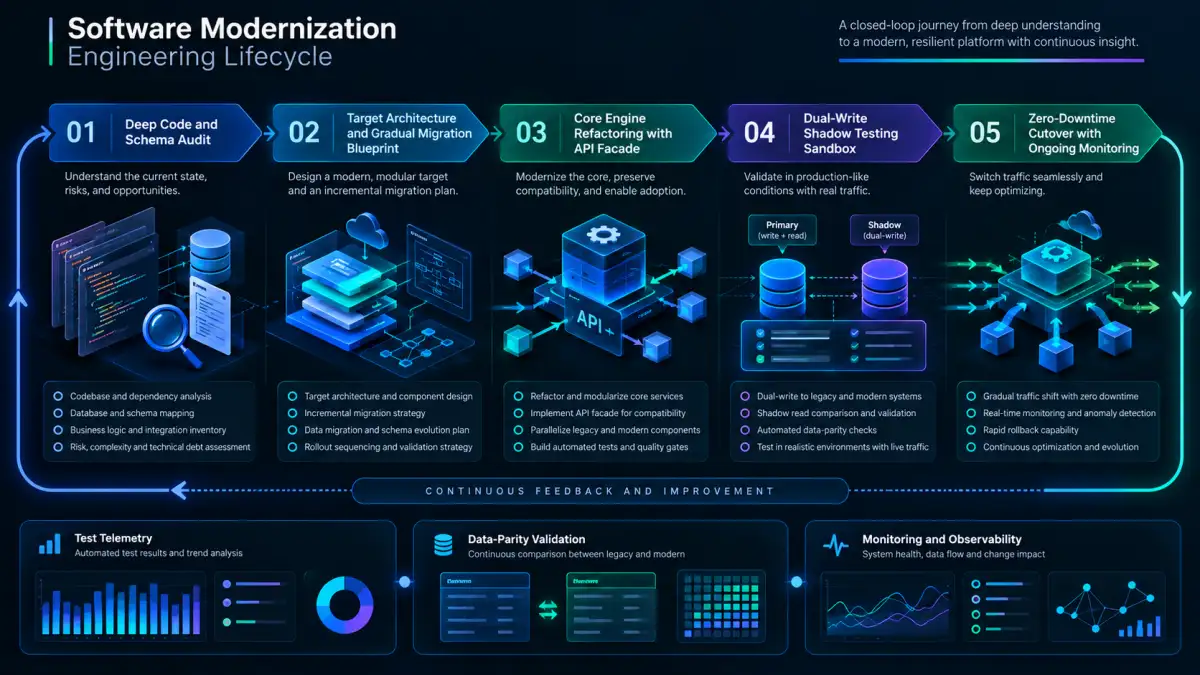
Dual-Write Shadow Testing Sandbox
Before cutting over live traffic, we run the modern application in shadow mode against live production requests. Both legacy and modern outputs are compared automatically to ensure 100% calculation and data consistency.
Modern Modular Architecture Powering Our Enterprise Suite
The same clean architectural standards, database normalization, and security hardening we apply to client modernization form the foundation of our enterprise platforms.
VheTM Modular Training ERP Core
Built on a decoupled, modular architecture that allows training academies to activate batch scheduling, certificate verification, and fee billing without monolithic bloat.
- Decoupled domain services allowing independent module deployment
- Sub-50ms database response times across millions of student records
- Full OpenAPI 3.0 REST endpoints for mobile app and LMS integration
EduSec Multi-Campus Scalable Engine
Engineered for high concurrency with normalized relational schemas, multi-branch data isolation, and automated database query optimization.
- Supports 50,000+ concurrent student and parent portal sessions
- Zero-downtime automated CI/CD deployment pipelines
- Automated audit logging and granular role-based access control
Rudram Double-Entry Accounting Core
A mathematically rigorous, ACID-compliant double-entry ledger engine engineered for instant trial balance calculations and automated statutory tax compliance.
- Strict relational schema integrity preventing ledger imbalances
- Automated real-time multi-currency conversion and bank reconciliation
- High-speed voucher generation with immutable transaction audit trails
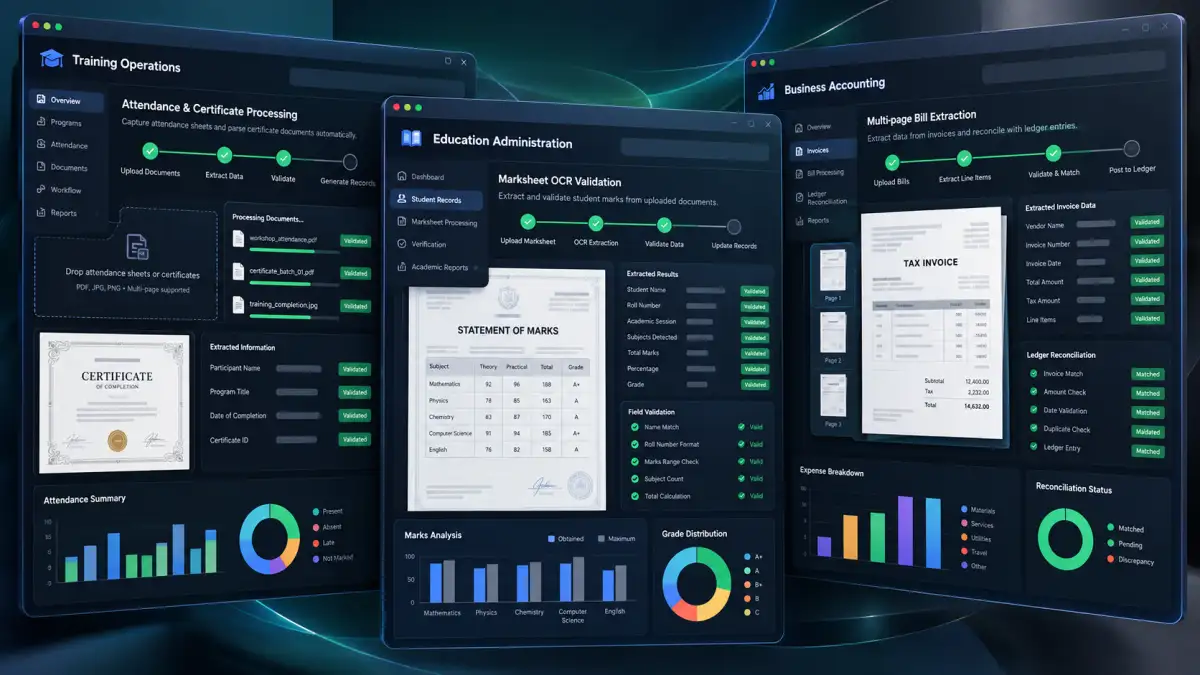
Tailored Software Modernization for High-Reliability Sectors
Every industry operates with distinct regulatory compliance, data retention rules, and workflow dependencies. We engineer modernization solutions adapted to your domain.
Education & Vocational Training
Modernizing aging student portals and campus databases to support mobile access, automated exam scheduling, online fee payments, and instant digital certificates.
Logistics, Freight & Supply Chain
Transforming legacy warehouse and dispatch applications into cloud-connected platforms with real-time barcode scanning, mobile driver apps, and API integrations.
Wholesale Commerce & Distribution
Upgrading desktop accounting and inventory packages into multi-branch web ERPs with centralized stock visibility, automated GST billing, and supplier portals.
Manufacturing & Industrial Operations
Refactoring proprietary shopfloor scheduling and production recording systems into modern web consoles with IoT telemetry and automated maintenance alerts.
Legacy Modernization Engineering in Action
Explore how our phased modernization frameworks eliminated technical debt, cured critical vulnerabilities, and restored operational agility.
Modernization of a 12-Year-Old PHP Monolith into a Modular Yii2 Cloud Platform for 40,000 Annual Trainees
A major vocational training institute relied on an unmaintained procedural PHP 5.3 codebase. The system crashed during peak batch registration, suffered from 12-second page loads, and had undocumented business rules that made new feature development impossible.
Applied the Strangler Fig pattern to refactor domain logic into modular Yii2 services on PHP 8.2, normalized 180+ database tables with automated checksum verification, and deployed containerized workloads with Redis caching.
Desktop Accounting & Inventory Database Re-Platforming into a Real-Time Multi-Branch Web ERP
A wholesale distributor operating across 5 regional branches used a brittle desktop database system. Branch managers had to manually email end-of-day Excel backups, resulting in severe inventory discrepancies, stockouts, and duplicate invoices.
Reverse-engineered the proprietary desktop database schema, sanitized corrupted records, and engineered a centralized cloud web ERP with real-time multi-branch stock synchronization and automated GST billing.
Related Software Engineering Capabilities
Legacy application modernization pairs directly with our core software engineering, ERP, and cloud infrastructure capabilities.
Custom Software Development
Bespoke backend architectures, domain microservices, and software systems designed around your operational requirements.
Custom ERP Development
Centralize operations across inventory, production, accounting, and workforce management into a unified enterprise platform.
API & System Integration
Secure RESTful APIs, payment gateways, messaging services, and legacy database synchronization pipelines.
Cloud & DevOps Engineering
Automated CI/CD build pipelines, containerized microservices, API gateways, and scalable cloud hosting infrastructure.
Software Testing & QA
Automated regression testing suites, load benchmarking, and rigorous OWASP security vulnerability assessments.
Application Maintenance & Support
Structured SLA maintenance plans with guaranteed response times, security updates, and performance tuning.
Frequently Asked Questions About Legacy Modernization
Clear, source-grounded answers about zero-downtime Strangler Fig migration, database verification, undocumented legacy systems, and security remediation.
How do you modernize our legacy application without disrupting our daily business operations?
We avoid high-risk "big-bang" rewrites. Instead, we use the industry-proven Strangler Fig pattern: we deploy an API Gateway / reverse proxy in front of your legacy system and extract functionality one bounded module at a time (e.g., Auth, then Billing, then Inventory). Dual-write database synchronization ensures both systems stay identical in real time, allowing a seamless, zero-downtime cutover module by module.
How do you guarantee that none of our historical data is lost or corrupted during migration?
We execute a multi-tier data verification protocol: 1) Automated schema reverse-engineering and data cleansing to identify orphaned records, 2) Cryptographic row-by-row SHA-256 checksum comparisons between source and target tables, 3) Automated financial balance and numerical reconciliation scripts, and 4) Dual-run shadow testing periods where both databases run concurrently before final sign-off.
Our legacy codebase has no documentation and the original developers are gone. Can you still modernize it?
Yes. We specialize in undocumented legacy systems. We use advanced Abstract Syntax Tree (AST) static code analysis tools to map code dependencies, reverse-engineer database Entity-Relationship Diagrams (ERDs), and interview your operational team to document all implied business rules and edge cases before writing a single line of replacement code.
What programming languages and frameworks do you use for modernization?
We build modern, maintainable backends using PHP 8.2+ with Yii2 or Laravel, Python FastAPI for specialized microservices, and PostgreSQL or MySQL 8 for robust relational data storage. Frontends are engineered using clean semantic HTML5, Bootstrap 5, and vanilla JavaScript for sub-second page performance without bloated client-side framework overhead.
How do you address critical security vulnerabilities in our outdated software?
We perform comprehensive security remediation: upgrading deprecated runtime versions to eliminate unpatched CVEs, upgrading outdated MD5/SHA1 password hashes to Argon2id/bcrypt, converting raw concatenated queries to parameterized prepared SQL statements (eliminating SQL injection), implementing granular RBAC, and enforcing TLS 1.3 encryption.
How long does an application modernization project typically take?
Because we work in phased incremental sprints rather than monolithic rewrites, you begin seeing production value early. Initial discovery and code auditing take 2–3 weeks, after which the first modernized module is typically deployed to production within 6–8 weeks. Total project duration depends on system scale, typically ranging from 3 to 9 months.
Who owns the modernized source code, database architecture, and intellectual property?
You own 100% of all modernized source code, database schemas, Docker configuration files, CI/CD pipeline scripts, and architectural documentation upon project milestone completion. We impose zero proprietary software lock-in or recurring per-user licensing fees.
Ready to Eliminate Technical Debt and Upgrade Your Legacy Systems?
Speak directly with a senior software modernization architect to audit your legacy codebase, evaluate technical risks, and plan a safe, phased modernization roadmap with zero downtime.